Introduction
The human brain is the center of our consciousness. It enables the cognitive processes, regulates the nonconscious processes, and coordinates the voluntary movements of our body.
Our brain receives sensory information from the five senses: sight, touch, smell, taste, and hearing. After this, it sends this information via chemical or electrical signals to the corresponding brain areas that process the received stimuli into a feeling, action, reaction, movement, or involuntary process of the body.
There are more than 100 billion neurons in the human brain. They create synapses among themselves and relay the sensory information to the processing centers located in the cerebral cortex. The brain stores this meaningful information into our short-term or long-term memory so that we could use these experiences at a later time.
What’s the Anatomy of the Human Brain?
The central nervous system consists of the brain and the spinal cord, while the brain itself comprises the cerebrum, cerebellum, and the brain stem.
The cerebral cortex is the largest part of the brain which receives neuronal fibers from all other functional structures of the brain.
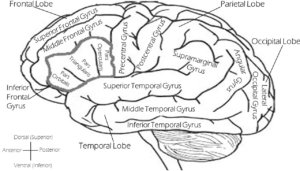
On the other hand, the cerebrum is the largest structure of the cerebral cortex. It comprises 4 processing areas of the brain, labeled as lobes: the occipital, temporal, parietal, and frontal lobe. They all constitute two equal hemispheres, just like the brain. Each one of the lobes controls and regulates a specific function in the brain.
Which Cortical Structures Comprise the Limbic System of the Human Brain?
Around the thalamus (located in the central part of the cerebral cortex), there’s a larger cortical organization of structures called the limbic system. The main parts of the limbic system are the hypothalamus, the amygdala, and the hippocampus.
There are several other cortical structures that also participate in the processes regulated by this limbic system, such as the basal ganglia and the cingulate gyrus.
What’s the Function of the Cortical Structures Comprising the Human Brain?
Cerebral Cortex
The cerebral cortex consists of two symmetrical hemispheres, labeled as the left and right hemispheres of the brain. The heavily folded surface, which gives us the most characteristic picture of the brain we have, comes from the folds and furrows called gyri and sulci.
The two cerebral hemispheres create the outer layer of the brain that is made up of gray matter. Underneath the gray matter, there is a layer of myelinated sheath labeled as the white matter of the brain due to its white color.
The cortical neurons relay the information received via sensory stimuli to the processing areas of the brain, dedicated to a particular function.
Thalamus
The center of the cerebral cortex is where the thalamus is housed. The thalamus is a cortical structure responsible for the transmission of the sensory information gained from the sensory stimuli to the other processing areas of the brain.
This part of the brain is involved in some of the most vital processes for survival, such as alertness and attention as well as memory and the sensation of pain.
Cerebrum
The cerebrum is made up of two symmetrical halves – the left and the right hemisphere. While the left hemisphere controls the right side of the body, the right hemisphere of the cerebrum controls the left side.
The two cerebral hemispheres are comprised of the following lobes:
- Occipital lobe;
- Temporal lobe;
- Parietal lobe;
- Frontal lobe;
- Insular lobe.
These hemispheres of the cerebrum are separated by a deep fissure known as the corpus callosum. This structure enables coordination of the cortical areas that are involved in the processing of language, memory, thinking, emotions, perception, and consciousness.
Occipital Lobe
The occipital lobe participates in the regulation and control of the following functions and aspects:
- Giving meaning to visual stimuli;
- Receiving sensory stimuli via the retina of the eyes;
- Determining the field of vision;
- Determining the objects within the field;
- Assessing the aspects of distance, size, and depth of the objects within the field;
- Relaying visual data from the sense of sight to the other processing areas of the brain;
- Control and regulation of the eyes;
- Color determination of objects;
- Recognition of faces;
- Ability to read and understand words.
Temporal Lobe
The temporal lobe is most active in the regulation and control of the following functions and aspects:
- Interpretation of language;
- Hearing;
- Memory;
- Sequencing of tasks;
- Organization.
Parietal Lobe
The parietal lobe is included in regulating and controlling the following functions and aspects:
- Interpretation of language;
- Meaning of words;
- Sense of touch;
- Feeling of pain;
- Temperature;
- Visual stimuli;
- Hearing;
- Motor stimuli;
- Sensory stimuli;
- Memory;
- Spatial perception;
- Visual perception.
Frontal Lobe
The frontal lobe is involved in the regulation and control of the following functions and aspects:
- Personality;
- Behavior;
- Emotions;
- Judgment;
- Planning;
- Problem-solving;
- Speaking;
- Writing ;
- Body Movement;
- Intelligence;
- Concentration;
- Self-awareness.
Brain Stem
The brain stem is the part of the brain in charge of the regular functioning of automatic processes, such as breathing, but it regulates the sleep cycles too. It connects to the brain via the spinal cord. This brain structure serves as the main ‘communication center’ of the cerebral cortex by relaying information via the cranial nerves.
The cranial nerves transmit the chemical or electrical signals from the senses of hearing, sight, taste, touch, and smell to the processing areas of the brain. In this way, they provide support to the autonomic functions performed by the brain stem – swallowing, regulation of breathing, eye movement, heart rate regulation, etc.
Cerebellum
The cerebellum is responsible for the consolidation of the motor information that is relayed to the muscles of the human body. Namely, this part of the brain aids the timing, planning, accuracy, and execution of our physical movements. It also controls the balance and posture of our body.
Consequently, the cerebellum plays a vital role in our everyday life, since it supports our walking, exercising, brushing our teeth, combing our hair, reaching for objects, etc.
Hypothalamus
This small part of the brain has a significant function in the synchronization of the physiological processes of the body. Located in the diencephalon, the hypothalamus connects with various processing areas of the central nervous system and the peripheral nervous system. In this way, it supports the fast transmission of the information between the neurons and the cortical structures.
Pituitary Gland
The pituitary gland (or hypophysis) is part of the endocrine system of the human body. Also labeled as the ‘master gland’, it regulates the function of the other endocrine glands.
The hormones secreted by the pituitary gland participate in the metabolic functions of the body, which are: regulation of temperature, pain relief, breastfeeding, pregnancy, childbirth, etc.
The list of hormones secreted by this ‘master gland’ contains the following items:
- The adrenocorticotropic hormone;
- Growth hormone (somatropin);
- Luteinizing hormone;
- Follicle-stimulating hormone (gonadotropin);
- The prolactin hormone;
- Thyroid-stimulating hormone;
- The antidiuretic hormone (vasopressin);
- The oxytocin hormone.
Pineal Gland
The pineal gland controls and regulates the circadian rhythm and the body’s internal clock. By secreting the hormone melatonin, this gland of the endocrine system participates in the sleep-wake cycle, regulates the metabolic processes, supports growth, and boosts the immune system of the body.
The pineal gland consists of 2 types of neuronal cells: the pinealocytes and the glial cells. While the pinealocytes are involved in the production of melatonin, the glial cells support neurotransmission in the brain.
Amygdala
The amygdala is the part of the brain involved in decoding the external sensory stimuli that are translated as fear, anger, aggression, or pleasure. It’s also involved in the processing of memories and motivation.
By activating the ‘fear system’ of the body, the amygdala plays a vital role in the survival of humans. Namely, when faced with a dangerous situation, this cortical structure signals the brain to alert all systems of the body to fight, defend, or escape the threat. This is the so-called ‘fight-or-flight’ response.
In addition, the appetitive stimuli are a positive reinforcement, also regulated and controlled by the amygdala. This type of stimuli triggers our consummatory behavior, i.e. the urge for the consumption of food, drinks, and everything that the brain recognizes as a pleasurable feeling.
Hippocampus
This part of the brain is involved in creating and storing long-term memories, translation, the regulation of our emotions as well as spatial recognition. By interacting with the amygdala and the hypothalamus, the hippocampus participates in a number of complex processes that take place in the cerebral cortex.
Learning is also one of the most notable functions of the hippocampus. Through the processes of forming, consolidating, encoding, and retaining memories, this brain structure aids the transfer of the learned skills and data from short-term into long-term memory.
Basal Ganglia
Composed of the thalamus, the cerebellum, and the frontal lobe, the main function of the basal ganglia is to coordinate the information exchanged between the other information-processing areas of the cerebral cortex.
Language and the Human Brain
The left hemisphere of the brain is considered to be the more dominant part of the brain. While the right part of the brain plays a significant role in processing visual stimuli and information, the left part of the brain is responsible for processing cognitive functions.
There are 2 main language processing centers in the human brain:
- Broca’s Area, and
- Wernicke’s Area.
Broca’s Area of the Brain
Broca’s area refers to the brain’s center for motor speech regulation and control. In addition, it also supports the physical movement of the lips, tongue, larynx, and the pharynx, required to produce speech.
Wernicke’s Area of the Brain
This section of the cerebral cortex is a specialized center for comprehension of spoken language as well as the control and regulation of language in all forms. This area helps us gain fluency in speech by controlling and regulating all aspects of communication.
Memory and the Human Brain
There is no single memory processing area in the brain. In fact, several structures of the cerebral cortex work together in order to translate the sensory stimuli, encode them, process them into meaningful information, and store them in short-term or long-term memory for our future reference.
Short-term Memory
Short-term memory consists of temporarily stored information and data required for learning, comprehension, or reasoning. We use this type of memory on a daily basis – while going to the store, reading, writing, following instructions, etc.
This type of memory also conducts data processing which aids in performing a particular task at a given time.
What Are the Types of Short-term Memory?
We can distinguish several types of short-term memory:
- Sensory (working) memory;
- Iconic (visual) memory;
- Echoic (imitative of sound) memory;
- Haptic (touch) memory.
The list of parts of the brain involved in the memory processes includes the following structures:
- The putamen;
- The prefrontal cortex;
- The hippocampus;
- The amygdala;
- The temporal lobe;
- The cerebellum.
Long-term Memory
Long-term memory refers to the brain’s ability to store learned information and skills for a long period of time. After the short-term memories are consolidated in the hippocampus, they are stored as long-term memories and integrated into the cortical structures of the brain for future reference.
What Are the Types of Long-term Memory?
There are 2 basic types of long-term memory:
- Implicit memory – This type of long-term memory includes procedural memory, priming, and classical conditioning;
- Explicit memory – This type of long-term memory includes semantic and episodic memory.
How Is the Human Brain Protected?
Our brain is primarily protected by the skull. The skull is a bony structure protecting the cerebral cortex structures from outside influences and physical blows. This ‘helmet-like’ protector of the brain is made of cartilage and 2 different groups of bones: the cranial bones and the facial bones.
On the inside, the brain is cushioned by the meninges. These membranes protect the cortical structures by enveloping them in cerebrospinal fluid, thus shielding them from any external injury or traumas.
Skull Bones
The skull is made of 8 cranial bones:
- the ethmoid bone;
- the sphenoid bone;
- the frontal bone;
- the occipital bone;
- two parietal bones;
- two temporal bones.
There is also a group of 14 facial bones, namely:
- two inferior nasal concha bones;
- two lacrimal bones;
- one mandible bone;
- two maxilla bones;
- two nasal bones;
- two palatine bones;
- a vomer bone;
- two zygomatic bones.
Meninges of the Brain
There are three meninges protecting the structures of the cerebral cortex:
- The Dura mater
- The Pia mater
- The Arachnoid mater
The spaces surrounding these brain-protecting membranes are called meningeal spaces. They are divided into:
- Subarachnoid space of the meninges
- Subdural space of the meninges
- Epidural space of the meninges
The cerebrospinal fluid supplies the cerebral cortex structures with nutrition, glucose, and oxygen, all of which are needed for the proper functioning and health of all parts of the brain.
Fun Facts
Did you know?
- The medulla oblongata is the most important part of the brain. This cortical structure is the most vital part of the brain since it houses the regulatory centers for breathing and proper functioning of the heart.
- It is possible for an individual to survive without a functional cerebellum.
- Amygdala is the part of the brain that controls emotions and feelings, especially those related to stressful situations and fear.
- The amygdala, hippocampus, cerebellum, and the prefrontal cortex, are the parts of the brain involved in information processing and the storing of our memories.
- We can control only a small portion of our conscious thoughts. The rest of our thoughts are controlled by the systems of our brain.
- The human brain is gray due to the gray matter that comprises its structures.
- The brain itself is not capable of feeling pain, but it signals the painful sensations to the corresponding areas that further process the sensory stimuli.
- The putamen and the insula are the parts of the brain involved in the control of feelings of hate.
- Our memories are strengthened in the brain during good, deep night-time sleep.
- A hard blow in the back of the head can shake our brain within the skull, and cause a concussion that can lead to temporary loss of brain function.